
EP 3 139 881 B1 relates to disposable absorbent articles and arrays of disposable absorbent articles which are designed to fit different adult body sizes, shapes and types, and as such are sized to fit a broad range of adult consumers.
The application was filed under the PCT as PCT/US2015/028156 and published as WO 2015/171377.
Brief outline of the case
The patent was revoked for lack of N over N over the prior art “Women’s Assurance Underwear“ and the proprietor appealed.
The board confirmed the revocation for lack of N over the prior art “Depend” and “Depend Silhouette“.
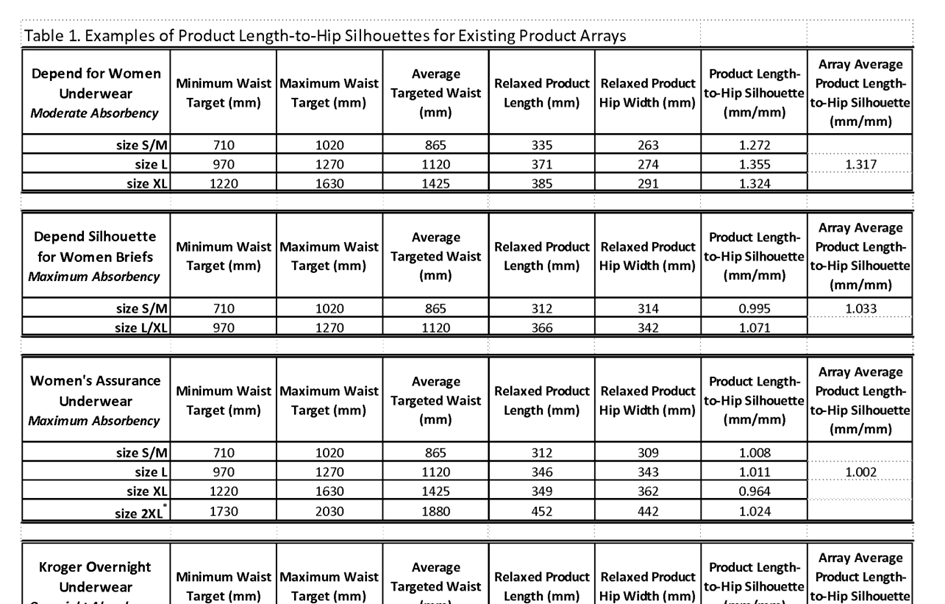
The prior art “Women’s Assurance Underwear” as well as the prior art “Depend” and “Depend Silhouette” were mentioned in Table 1 of the application as filed having the title “Examples of Product Length-to-Hip Silhouettes for Existing Product Arrays”.
Here is an excerpt of this table:
We will concentrate in the present blog on how the board assessed the prior art mentioned in the application as filed.
The proprietor’s point of view
The proprietor argued in its grounds of appeal that the disclosure in Table 1 of the patent application was not itself prior art owing to the fact that it was not made available to the public before the filing or priority date of the patent.
The proprietor argued more specifically that there was no evidence that different articles from the “Depend” and “Depend Silhouette” arrays ever existed in the same location, e.g. geographical region, and at the same time, e.g. year.
The proprietor further argued that the “Depend” and “Depend Silhouette” articles also did not form an array, since these articles were not “like article constructions” necessary to form an array according to the definition in paragraph [0017] of the patent. According to the proprietor, paragraph [0017] defined like article constructions as needing to have the same elastomeric materials in the flaps and this was not the case for “Depend” and “Depend Silhouette” articles.
The board’s decision
The “Depend” articles in the sizes L and XL form an array with the “Depend Silhouette” article size S/M, the “Depend”+”Depend Silhouette” array.
The size L, the size XL and the size S/M correspond to the first, second and third absorbent articles, respectively. This array has all the features of claim 1.
Table 1 discloses parameters for “existing product arrays”, identified by the commercial name of their absorbent products, to be used as comparison to the arrays of the invention defined in the claims.
These are also referred to on page 8, lines 18-20, and page 10, lines 15-16, as “currently” or “today’s” marketed products.
The board had no doubts that in order for their properties to be listed in Table 1 at the priority/filing date, these products were necessarily commercially available before the priority date in order for the proprietor to be able to perform the necessary measurements and calculations shown in Table 1.
Even if the parameter measurements on the articles seen in Table 1 were never performed publicly or at least were never made available before the priority date, these are intrinsic properties of the articles which are thus considered to have been made publicly available. The board referred to G 1/23, Reasons 73, 90 and 91, and to G 1/92, Reasons 1.4, 2 and 2.1.
As far as the second argument is concerned, the board held that the expressions on page 8, lines 18-20, and page 10, lines 15-16, “currently” or “today’s” marketed products imply that the products were commercially available at the time that the proprietor drafted the application and performed the measurements and calculations.
As far as the third argument is concerned, the board considered that “like article constructions” is a broad expression. Even if there are two examples in paragraphs [0017] and [0018] of articles with different elastomeric materials corresponding to different arrays, having the same elastomeric materials in the flaps is referred in paragraph [0017] are only one of the possibilities, cf. “e.g.”, is enough for articles to be considered as having a like construction.
It is also stated in paragraph [0017] that articles having the same graphic elements also have like article construction. Having the same elastomeric materials in the flaps is thus not a necessary condition for the articles to be part of an array.
Comments
Table 1 was deleted in the description just before the ED decided to grant a patent. One wonders why?
In any case the ED should not have allowed the deletion of Table 1. One could also consider that the deletion of Table 1 infringed Art 123(2) as it shed a different light on the invention.
The present case should be a warning to applicants. If you mention in your application as filed “Existing products”, it means, be it under G 1/92 or G 1/23, that those products must have been available to the public before the filing date of the application or before the claimed priority date.
In an old paper C, relating to a device for cleaning a paint roller, said paint roller was mentioned as “conventional” in the description of the patent. As the paint roller was “conventional”, the EQE Examination Board expected a N attack on the roller which was claimed as such next to the cleaning device. “Conventional” means available at the filing/priority date.
The problem with non-public or internal prior art mentioned in the description-
Starting with T 22/83, there is a number of decisions considering that prior art acknowledged in the introductory part of description ought to have been publicly available in order for it to be taken into account for the assessment of IS.
T 22/83 was soon introduced in the Guidelines, and allowed applicants/proprietors to delete any mention of this allegedly “internal” prior art in the introductory part of the description during examination or opposition.
This way of looking at “internal” prior art was challenged in T 1227/10.
In T 1227/10, the board held that the deletion of original figure 1 labelled as prior art and of the corresponding part of the description in the original application has modified the application in a way that the granted claim 1 includes subject-matter which was excluded from the originally filed invention, as it would have been understood by a skilled person on reading the whole original application on the date of filing.
The board also referred to G 3/89 OJ 1993, 117, Reasons, 1.3, 1.4 and 1.6, which states the prohibition of added matter under Art 123(2) applies also in the case of a correction.
I have great sympathy for the view of the board in T 1227/10, and considers the view expressed in T 22/83 and the like as not being correct.
Comments
Leave a comment