
We completed this year’s second update of our EPC.App reference book to legal status of 1st November 2026. As always, it is available in terms of English and German versions with same content. This meanwhile 17th edition of our EPC commentary covers all Official Journal articles until October 2026 with thereby implied changes of EPC provisions and is dedicated for use in EQE 20271.
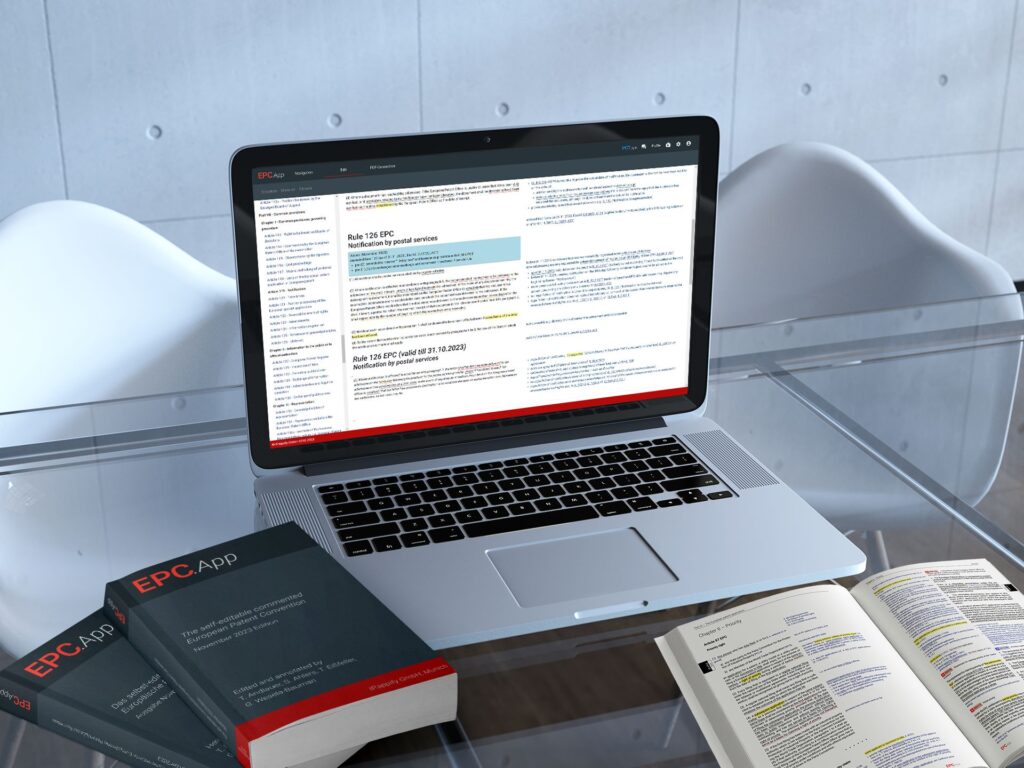
Key changes since the last content update in April 2026 were:
- The latest case law of the Boards of Appeal
- G 1/25 (open in EPC.App at A. 84) has been issued in September to answer the long-waiting question of whether it is necessary to adapt the description to amended claims. The answer is not what most applicants and their representatives had been hoping for. It rather requires removing an inconsistency between the claims and the description where it leads to non-compliance with Articles 52 to 57, 76(1), 83, 84, 123(2) or 123(3) EPC, and allows retaining it only if not relevant for the assessment under the EPC. As an obiter dictum, the Enlarged Board states that the description is almost always finalised in the oral proceedings before the Board of Appeal. Let’s hope that the Technical Boards will consistently follow this and no longer revoke patents for description adaptations being filed late.
- A new referral G 1/26 has further been accepted by the Enlarged Board (T 873/24 at A. 123). It will hopefully bring more clarity to the application of G 1/24.
- The 11th edition of the Case Law of the Boards of Appeal book has received a new revision published in July 2026 (see here). In the EPC.App, all references to the 2025 version have been updated and selected new ones have been added (for example case law after G 1/24 at A. 69).
- In addition to this, the integrated case law database of the online EPC.App has been complemented by all BoA decisions published until end of October 2026. Further decisions thereof can be added or cited in personal annotations as needed using the self-editing functions (illustrated in this video).
- Rule 152(11) EPC has been amended as of 01 June 2026 (at A. 133). For the authorisation of an association of representatives to be effective for a representative being a member thereof, it now requires registration with the EPO instead of evidence to practice within the association.
- The consolidated Rules for European patents with unitary effect (UPR) have been included in the EPC.App database (so far available only via Official Journal articles) and links thereto have been added to the comments. Selected rules have further been added to the book in full text, namely R. 6, 7, 20, 22 UPR at A. 142 EPC; R. 4 UPR at A. 143; and R. 8, 11, 12, 13, 14 UPR at A. 147. The EPC.App database has further been complemented by the full texts of Regulation (EU) No 1257/2012 (OJ 2013, 111) and No 1260/2012 (OJ 2013, 132), as well as the UPCA with links thereto in comments at A. 149a. Users can now include further details of these provisions as needed. It is recommended to make use of that when preparing for the EQE.
- The Republic of Moldova has acceded the EPC effective as of 01 June 2026 and thereby became the 40th EPC member state (at A. 3). It leads to automatic designation of this state for applications filed on or after 01 June, while the terminated validation agreement remains applicable for applications with an earlier filing date (at A. 79).
- The continuous modernization of processes at the EPO resulted in that:
- ePCT can be used for notification by the EPO as rO, ISA or IPEA as of 01 June 2026 (OJ 2026, A28 at A. 119).
- PACE requests can be filed via MyEPO as of 01 October 2026, which also provides new functionality for bulk PACE requests (OJ 2026, A44 at A. 94).
- Following the EPO departments, from 01 November also the Boards of Appeal introduce audio recording of oral proceedings for preparing minutes using AI (OJ 2026, A54 at A. 116).
The above links to the online versions of the book can be followed when being logged-in. A free one month test account is available (does not extend automatically after expiry).
As usual, all changes of the update are automatically included in the online version on the next login. And as part of our update service, changes are additionally indicated by about 30 brief blue update notes in the App. Of course, self-edited user content from before the update is retained in the respective personal storage on the webserver, and can be exported into the printable PDF offline version so as to avoid time-consuming transfer of handwritten annotations to the new edition. The update process and related functions are further explained in the FAQs and this 2-minute youtube video.
To further avoid the need of replacing pages in a folder, a customized color paperback with up-to-date content and typed user comments can be ordered via our integrated high-quality print-on-demand service.
Note that this is the first edition after the major software update in July 2026. PDFs generated thereafter have slightly improved line and page breaks which may lead to page shifts compared to older PDFs.
For those who still prefer to start with a classical printed book, we published also the EPC.App November 2026 Edition as stand-alone black-and-white paperback. The book is available in English and German via Amazon.
Our revision cycle has been changed to May and November so that the next EPC.App update will come in May 2027. It will include several changes already published in the Official Journal about mandatory electronic filing and notification which will enter into force on 01 April 2027.
- Parts coming into force on 1 November after the EQE cut-off date 31 October are clearly indicated in the book. The only aspect in this edition is OJ 2026, A54 about the audio recording of oral proceedings before the Boards of Appeal. In practice, it is anyway not a realistic fear to get punished in the EQE for applying provisions which enter into force after the cut-off. It is rather advisable to become familiar with changed provisions early. ↩︎
Comments
Leave a comment